Nature Medicine Research Summary: Sepsis Mortality Reduction with Bayesian Health
Three recently published large, prospective multi-site cohort studies, conducted in collaboration with Johns Hopkins University, are some of the largest, most comprehensive and rigorous evaluations ever undertaken in the field of AI-driven clinical decision support for using multi-modal data to improve patient outcomes*.
These results, showing high provider adoption and associated mortality and morbidity reductions*, are a milestone for the field of AI and are the culmination of nearly a decade of significant technological investment, deep collaboration, the development of novel techniques and, for the first time, rigorous evaluation.
Remarkable Results In Real-World Settings
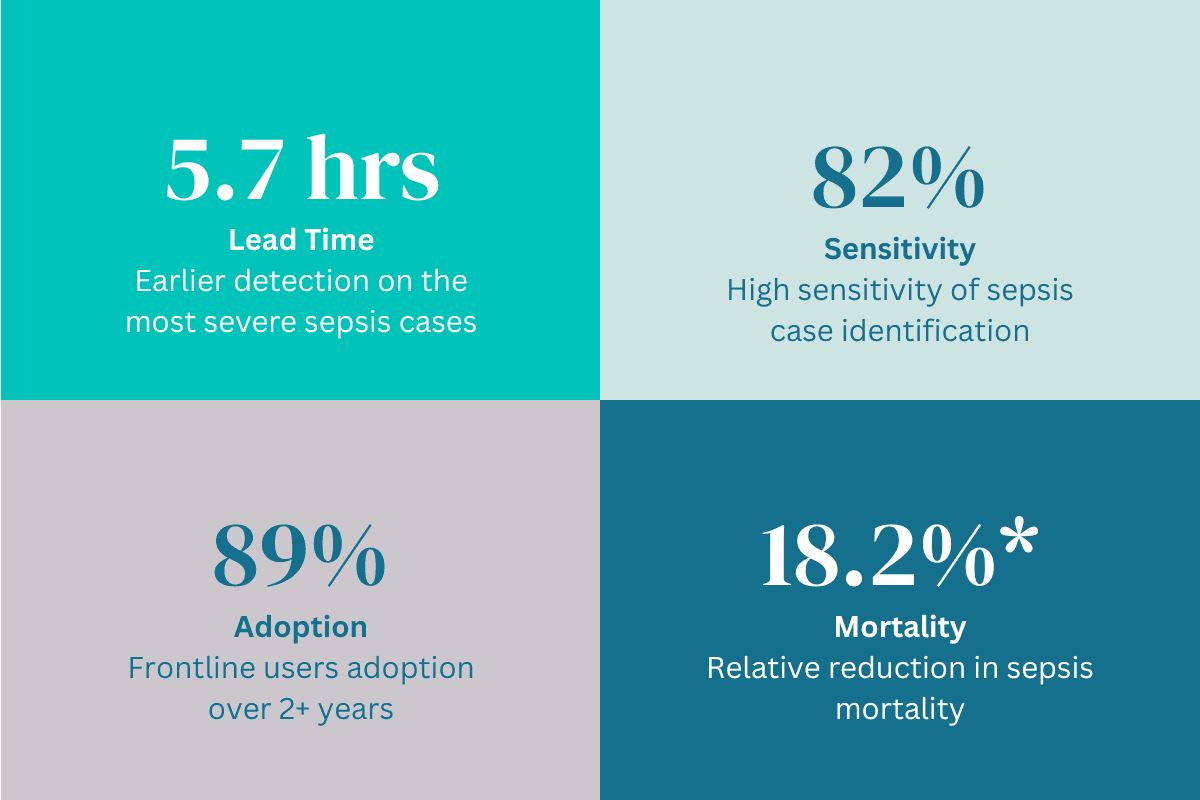
Using data from 764,707 patient encounters (17,538 with sepsis) across five hospitals in both academic and community-based hospital settings with 2,000+ providers using the software, this research shows accurate early detection (1 in 3 cases were physician confirmed) at high sensitivity (82%) and significant lead time (5.7 hours earlier), high provider adoption (89%), and associated significant reductions in mortality, morbidity and length of stay*.
Most significantly, the studies show timely use of Bayesian’s AI platform is associated with a relative reduction in mortality of 18.2%*.
Read the Studies
Nature Medicine: Factors Driving Provider Adoption of the TREWS Machine Learning-Based Early Warning System and Its Effect on Sepsis Treatment Timing
Nature Medicine - Prospective, Multi-site Study of Patient Outcomes After Implementation of TREWS Machine Learning-Based Early Warning System for Sepsis
npj Digital Medicine - Human-Machine Teaming is Key to AI Adoption: Clinicians’ Experiences with a Deployed Machine Learning System
World-Class Researchers
This research was led by Suchi Saria, PhD conducted in collaboration with Dr. Albert Wu and a group of researchers from Johns Hopkins University. The team includes senior practicing physicians and nurses, clinical, human factors and machine learning researchers, and hospital administrators with expertise spanning patient safety and outcomes research, infectious diseases and health system administration.
Size of the Research
Conducted over a five-year period at five hospitals in both the academic and community-based hospital settings and across every department (including the ED), the studies included data from 764,707 patient encounters (17,538 were septic). In the prospective deployments spanning 2.5 years, over 4,000 caregivers (2,000+ were providers) participated in the research, using Bayesian’s adaptive AI platform to help augment their care of patients and empower their decision and documentation processes.
While retrospective studies have demonstrated the theoretic capacity of AI/machine learning-based models to detect various conditions early, few studies have reported on clinical implementations of these models to effectively monitor, tune and learn over time to continually improve performance. Additionally, there haven’t been any studies that have associated adoption amongst thousands of providers using the tool across multiple sites and settings with actual reductions in mortality.
Scope of the Research
There has been a lot of research published focusing on CDS for sepsis detection, but most included far fewer patients and often only a single site or one or two units within the hospital. Nothing has approached the size of these studies. Likewise, the diversity of the settings where this platform was deployed (community and academic hospitals and all of their associated units) better represent real-world deployment and application.
This longitudinal approach, where we monitored patients beginning in the ED, through every transition and on to discharge, was key in achieving the reduction results in mortality. The scope of this research shows the relevancy of this approach no matter the setting, whether it be a standalone community hospital or a large academic medical center.
Beyond Sepsis
While this research focuses on the efficacy of Bayesian’s adaptive AI platform for early detection of sepsis, the solution is configured to target a wide-array of condition-specific use cases* such as clinical deterioration and pressure injuries. This modular approach allows hospitals and health systems to leverage their Bayesian deployment to tackle multiple, high-priority patient care challenges and scale their investment across the enterprise.